
Does Abortion Cause Breast Cancer?
Although considered inconclusive at this time, many argue there is evidence supporting the theory that an abortion or miscarriage before 32 weeks of pregnancy can increase risk of breast cancer. Any form of pregnancy termination, including premature birth, miscarriage, or abortion, before 32 weeks’ gestation impedes the natural growth and maturation of the breast tissue, which is believed to raise the probability of developing breast cancer.
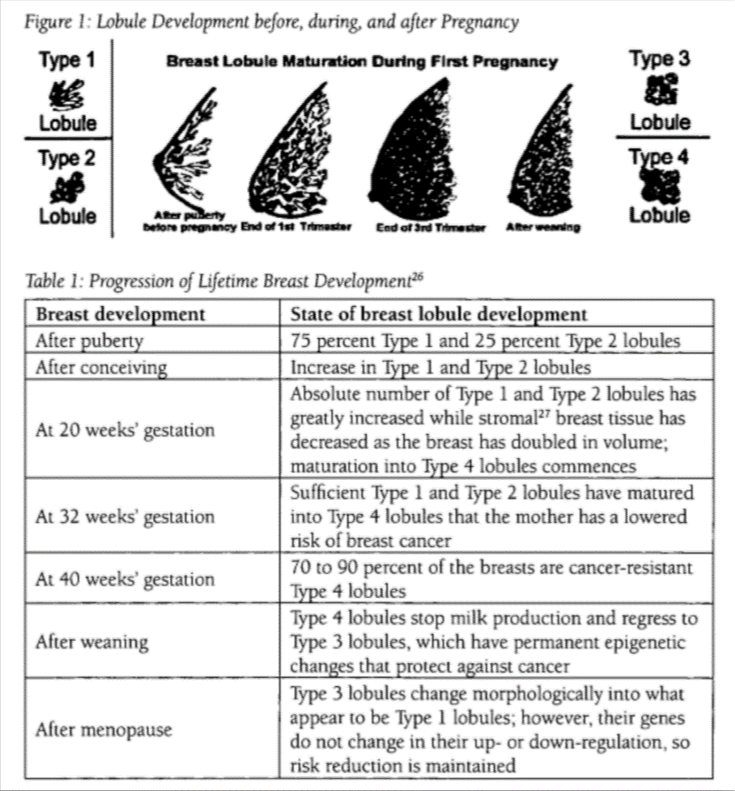
During the first 32 weeks of pregnancy, the breast increases in cancer-susceptible lobules. Lobules, which include milk ducts and surrounding mammary glands, are made up of individual cells. After puberty but before a full first-term pregnancy, women only have Type 1 and Type 2 lobules, which are cancer-susceptible because they have not fully matured. As pregnancy progresses toward 32 weeks, the breast develops more Type 1 and Type 2 lobules, nearly doubling their number. This increase raises the amount of cancer-susceptible tissue. If a pregnancy ends during this period, the risk of cancer remains elevated until a subsequent pregnancy develops past 32 weeks.
Between 20 and 32 weeks of gestation, Type 1 and 2 lobules begin maturing into Type 4 lobules, which are described as cancer resistant. 32 weeks is the milestone where the majority of Type 1 and 2 lobules have matured. By the end of a full-term pregnancy, once lactation begins, 70 to 90 per cent of lobules have matured into Type 4, making the breast resistant to cancer. Each subsequent full-term pregnancy is said to reduce the risk of breast cancer by an additional 10 per cent.
After lactation, Type 4 lobules regress to Type 3 but are believed to maintain their cancer-resistant properties. Following menopause, there is further mild regression to Type 1 lobule.
Therefore, while pregnancy provides natural protection against breast cancer, terminating a pregnancy before 32 weeks significantly increases risk. Also, the longer a woman waits to become pregnant, the higher her risk becomes because cancer-susceptible cells remain exposed to environmental carcinogens for a longer period. The period of time between puberty and pregnancy is known as the “susceptibility window.”
From this perspective, an abortion may increase a woman’s risk of breast cancer, while carrying a pregnancy to term may reduce it. According to this theory, abortion not only affects the unborn child but may also have long-term health consequences for the woman.
References
Lanfranchi, A. E. (2014, Spring). Breast cancer and induced abortion: A comprehensive review of breast development and pathophysiology, the epidemiologic literature, and proposal for creation of databanks to elucidate all breast cancer risk factors. Issues in law & medicine. https://pubmed.ncbi.nlm.nih.gov/25189012/. Accessed October 22, 2024.